
Basic information about this product
Safety and hazard classification
 GHS02
GHS02
 GHS05
GHS05
 GHS07
GHS07
Important safety instructions and precautions
Signal Word: Danger
UN No.: 1915
IMCO Class No.: 3
Packing Group: III
Hazardous Statement: H226 - H302 + H312 + H332 - H315 - H318
Precaution Statement: P210 - P280 - P301 + P312 - P303 + P361 + P353 - P304 + P340 - P305 + P351 + P338
Detailed information about the product
Product Overview
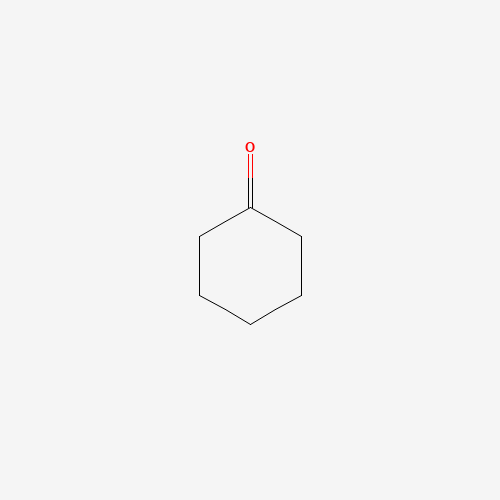
Cyclohexanone 99% For Synthesis (CAS No. 108-94-1) is a saturated cyclic ketone containing a carbonyl group within a six-membered cycloaliphatic ring. Its carbonyl functionality undergoes characteristic reactions including nucleophilic addition, condensation, reduction and oxime formation, while the adjacent methylene groups permit enolate formation and subsequent carbon–carbon bond-forming transformations. These structural features make cyclohexanone a versatile starting material for preparing oxygen- and nitrogen-containing cyclic compounds.
The Synthesis grade is intended for preparative organic chemistry and laboratory-scale transformations in which cyclohexanone serves as a ketonic substrate or synthetic intermediate. Reaction with hydroxylamine produces cyclohexanone oxime, which can undergo Beckmann rearrangement to ε-caprolactam, while Baeyer–Villiger oxidation provides access to ε-caprolactone. Cyclohexanone also participates in reduction, aldol condensation and other carbonyl-based transformations used in the preparation of functionalised cyclohexane derivatives.
Typical Applications
Common Synonyms
Storage Conditions
Store in a tightly closed container in a cool, dry, well-ventilated place, protected from direct sunlight and excessive heat. Minimise prolonged exposure to air and reseal promptly after dispensing to limit evaporation and changes in composition.