Basic information about this product
Safety and hazard classification
 GHS07
GHS07
Important safety instructions and precautions
Signal Word: Warning
Hazardous Statement: H302-H312
Precaution Statement: P280-P301+P312-P302+P352
Detailed information about the product
Product Overview
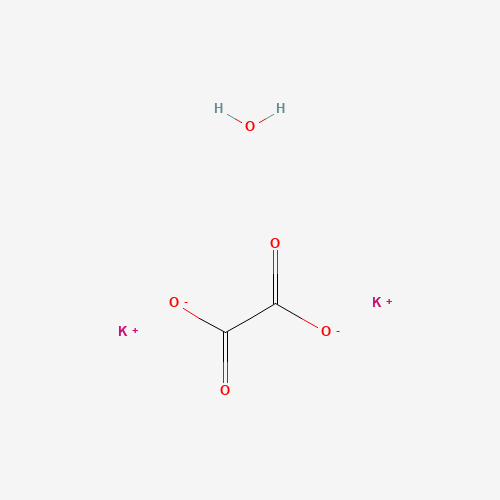
Potassium Oxalate Monohydrate 99.5% AR/ACS (CAS No. 6487-48-5) is the hydrated dipotassium salt of oxalic acid and provides the divalent oxalate ligand in aqueous analytical media. Oxalate forms complexes with many metal ions and precipitates selected cations as poorly soluble oxalate salts, while its reducing behaviour can also be exploited in suitable redox systems. These properties give the reagent recognised roles in classical inorganic analysis and metal-ion chemistry.
The AR/ACS grade is positioned for conventional precipitation, complexation, wet-chemical reagent preparation and quality-control procedures.
Typical Applications
Common Synonyms
Storage Conditions
Store tightly closed and minimise uncontrolled moisture exchange to preserve the defined monohydrate state and reproducibility of weighed analytical preparations. Protect the reagent from contamination by polyvalent metal ions because such contamination can consume oxalate through complexation or precipitation.